The fortress
The fortress and its halls
A short history of Hohensalzburg Fortress, the prince-archbishops who built it, and the three halls that host the concert in different seasons.
Book the fortress concert ↗Quick answer
Hohensalzburg Fortress was begun in 1077 and enlarged by Salzburg's prince-archbishops over centuries. The concert is held in one of three halls: the Golden Hall, a late-Gothic state room, the Arms Hall in the fortress restaurant, or the Castle Hall in the castle tavern. The booking page decides the hall by date.
Begun in 1077
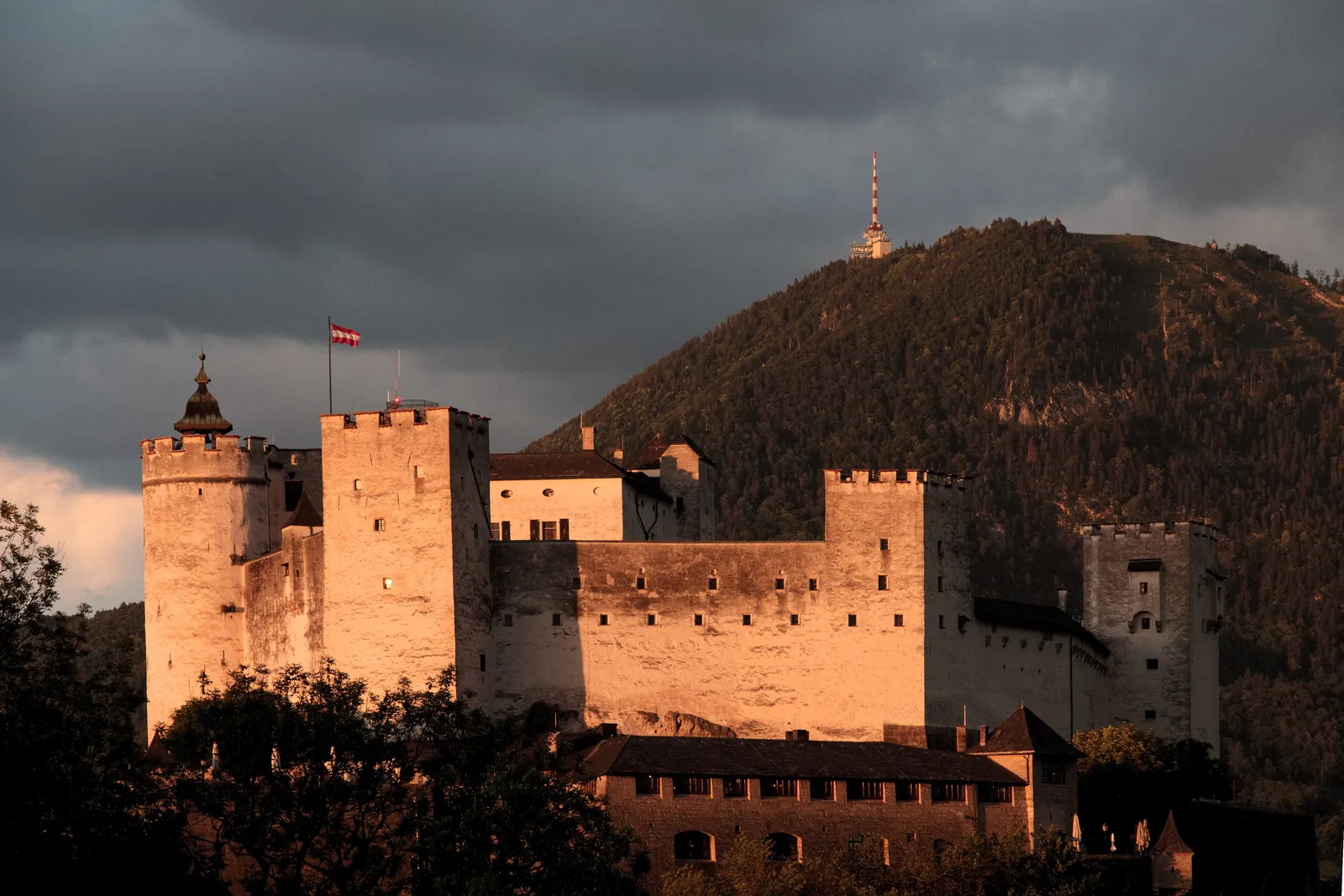
Wikipedia says an earlier Roman fort stood at the highest point, and that construction of the present fortress began in 1077 under Archbishop Gebhard von Helfenstein as a simple bailey with a wooden wall. His conflict with Emperor Henry IV shaped its growth. The ring walls and towers were added in 1462 under Prince-Archbishop Burkhard II von Weißpriach. The fortress now covers 32,000 square metres, says its own site, and ranks among the biggest castle complexes of Central Europe.
Keutschach's rooms
Archbishop Leonhard von Keutschach, who ruled from 1495 to 1519, expanded the fortress and had the state rooms fitted out on its third floor. The fortress's visitor page dates the Prince's Chambers to 1501 and 1502 and calls the suite a unique ensemble of late-Gothic rooms, better preserved in Salzburg than anywhere else in Europe. The Golden Hall, the Golden Chamber and the bedchamber belong to it. Keutschach's emblem, the turnip, appears in many places in the fortress.
The Golden Hall
Wikipedia describes the Golden Hall as richly decorated, with a coffered ceiling in which each coffer carries a gold button for a star. A beam about 17 metres long carries painted coats of arms of the Holy Roman Empire, of powerful German towns and of the bishoprics tied to Salzburg. Four marble pillars and a loggia were added to gain space. The concert booking page lists the Golden Hall for the warm months and notes that it has many steps and no elevator.
The Arms Hall and the Castle Hall
The fortress's own website lists the Arms Hall among the rooms of its Panorama Restaurant and the Castle Hall as part of the castle tavern. These are the other two halls on the concert booking page: the Arms Hall for much of the colder season and the Castle Hall around Advent and New Year. The fortress describes the Castle Hall as historic and the tavern's Gothic barrel vault as charming. Dinner guests dine in the same restaurant, which also has two terraces with views of the city.
Sieges, soldiers and tourists
The only time the fortress came under siege was in 1525, in the German Peasants' War, and the attackers failed. In 1800 it surrendered to French troops without a fight. In the nineteenth century it served as barracks, store and dungeon before it was given up as a military post in 1861. Wikipedia says refurbishment began in the late nineteenth century, and the funicular of 1892 made the hill a visitor attraction.
A bull, a railway and a trumpet tower
The Salzburg Bull is a large mechanical organ in the Krautturm, built in 1502 by Keutschach and renewed in 1735, says Wikipedia. The Reisszug, a goods railway into the upper courtyard, was first documented in 1515 and is probably the oldest operational railway in the world. The fortress adds that a trumpeters' tower went up in 1465, where watchmen signalled approaching dangers, and that tower music is still played on Sundays.
A hill inside a World Heritage site
UNESCO has listed the historic centre of Salzburg since 1996, and Wikipedia says the listed core zone includes the Festungsberg, along with the Mönchsberg and the Kapuzinerberg. The fortress stands on the second of those hills, above the rest of the old city.
Who this isn't for
If you want to see the state rooms, the museums and the Magic Theatre, the concert ticket is the wrong one: those need a daytime admission ticket, which is a separate product. The concert shows you one hall and the way up and down, and the view from the hill.
Sources